I’ve been taking pictures all my life. My parents bought me my first camera – a Kodak Instamatic – when I was 10 years old. I took pictures of everything: people, places, animals, nature, and inanimate objects. It didn’t matter what, I just loved taking pictures. One of the most exciting things about photography back then was taking rolls of undeveloped film cartridges to the local drugstore and waiting days to see the prints once they were ready. They’d come back freshly delivered in yellow Kodak envelopes with center dividers separating the prints from the negatives. I still have hundreds of them.
It was also a time when I developed a lifelong interest in history. Growing up in Boston, my parents would take me to all the historic Revolutionary War-era sites, where, naturally, I’d take lots of pictures. I was 16 when we moved to Northern Virginia, just across the Potomac River from Washington DC., and I spent the entire first summer there exploring our nation’s capital. Later, during my college years at Virginia Tech, I visited many of the Civil War-era battlefields, such as Gettysburg, Manassas, and Antietam. These places left an indelible mark on me.
Chicago, Mercury Train Leaving Chicago 1936 / 2020

Flash forward 50 years.
When I turned 60, preparing to retire from a career in marketing and advertising, I began to think about what I would do next. I had been taking pictures all my life, and by now photography had gone digital. Over the years I acquired some high-end equipment, including a NIKON D850 professional camera and a half dozen top lenses. I also taught myself Photoshop and other photo software programs.
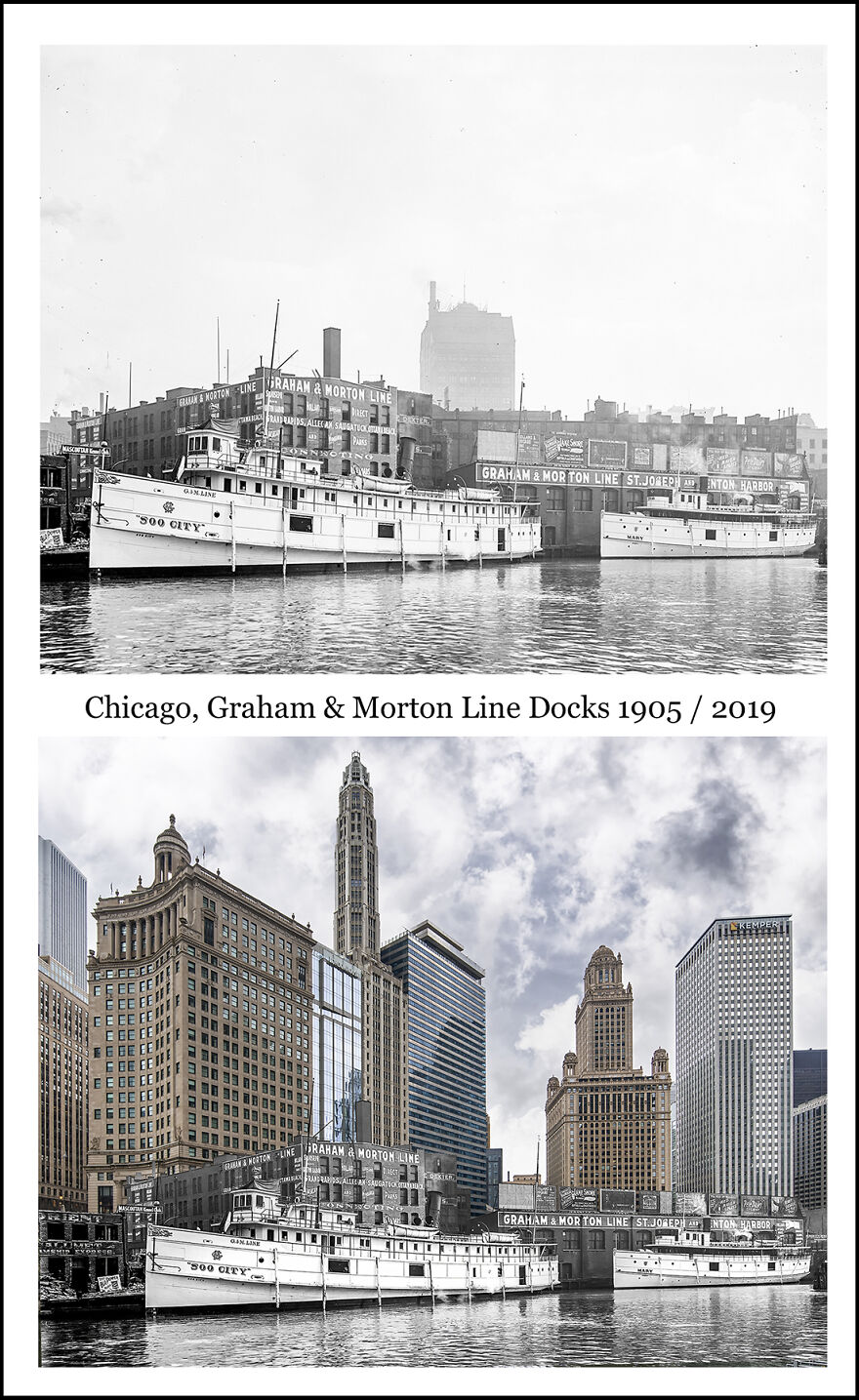
Then one day in 2016 I came across some really old pictures of Chicago, where I have lived for over 20 years. These pictures date back to the late 1800s and early 1900s. I thought it would be interesting to find those locations, take identical pictures a hundred years later, and compare them to the originals. I took a few and looked at them side by side with the originals. I didn’t even know there was a name for this: rephotography – pictures taken of the same place from the same vantage point at two different moments in time.
Fire! Chicago Fire Of 1871 / 2021

Boston, Quincy Market 1900 / 2018

As interesting as it was looking at these images side by side, I thought it would be even more interesting to digitally blend them together, creating a single image that was part old and part new. I did a few of them and showed them to my friends. They were blown away. They suggested I show my work at art fairs and festivals. So, I did! But first, I needed a greater body of work.
By 2017 I had created 10 images. I applied to a few art shows in Chicago, and to my complete shock, I was accepted into all of them! Not only that, I won several awards, got a bit of local publicity, and invitations to return the following year. But more importantly, people were buying my photographs!
I began amassing dozens of historical photographs of cities all over the country. I traveled to these cities, found the exact locations, took all the photographs, then went home, created my blended images, and applied them to local art fairs. I called my collection “Time After Time”. By 2018, I was exhibiting at prestigious art festivals in Chicago, Boston, New York, and Washington DC. My booth was packed at every show. No one had ever seen anything like it. Sales were beyond my wildest imagination. I now had a second career – as a fine art photographer!
New York, A Bird's Eye View Of New York 1851 / 2020

New Orleans, Canal Street 1907 / 2019

Now, at the start of 2023, I have created over 500 images across 17 U.S. cities, plus London, England, and Havana, Cuba. I’ve published 7 Time After Time books and have my own art gallery. I’ve been commissioned to create custom pieces for individuals and corporations. Perhaps my biggest honor was a commission to create a series of images of George Washington’s Mount Vernon estate, where my work is featured: at the home of the first President of the United States!
The stories I could tell would fill volumes. The best way to tell them is to answer some of the questions I frequently get asked.
London Bridge 1900 / 2022

Fire! San Francisco Earthquake And Fire Of 1906 / 2022

How do you do it?
It starts with the right source images. They must be in high resolution, or they won’t enlarge well enough to print. I obtain these images from historical societies, museums, libraries, universities, the Library of Congress, the National Archives, and other institutions. Once I have the source image, I go out, find the exact location, and take my shot, using great care to match the angle, perspective, focal length, and lighting…even waiting for the right time of day so that the shadows align. Shutter speeds and apertures play a role too. I like to say that my work is part science and part art. Science is doing all those things correctly. Art is what creates the final blended image. There’s no right way or wrong way to do it. I just look for the most compelling pieces in each photo and try to create a seamless, believable transition between old and new.
How long does it take to create an image?
It depends on when you start the clock! I spend thousands of hours researching, finding, obtaining, and restoring source images, traveling to different cities, doing the shooting, cataloging everything, and then sitting down to edit. Each picture takes anywhere from 8 to 16 hours of editing. It’s almost funny to call myself a photographer because taking a picture is the least of what I do!
Chicago, Graham & Morton Line Docks 1905 / 2019
Havana Cuba, The Prado Looking North 1901 / 2019

What was your favorite city to shoot?
I like different cities for different reasons. Chicago is my home, so I have a greater selection of images from here than from any other city. New York and Los Angeles are always exciting cities to visit, and I’ve shot in both cities twice. I think my San Francisco set is unique because all the source images were taken in 1906, in the aftermath of the Great San Francisco Earthquake and Fire. My San Francisco collection shows how the city was rebuilt after the fire. New Orleans was a lot of fun too. But there’s so much great food and drink in New Orleans, I had to remember to carve out some time to work!
Los Angeles Street North From First Street 1910 / 2021

Houston 1873 / 2022

Do you have a favorite image?
With over 500 images to choose from, that’s a tough question. I have some personal favorites for different reasons. In each city, one of my images becomes my signature piece, the one everybody loves. In Chicago, it’s “State Street South Lake Street”; in New York, “Brooklyn Bridge”; in Boston, “Quincy Market”; in London, “Houses of Parliament”. I have other favorites too, because of the history embedded within the photograph. One such piece is “Randolph Street East From Dearborn Street, Chicago”, a piece I created last year. The source image was taken in 1914. On the side of a building, you can see a white sign. It is an advertising sign from Cunard Lines, the famed steamship company promoting the voyages of three of the world’s biggest passenger ships: Aquitania, Mauritania, and Lusitania.
Two years before the picture was taken, on April 15, 1912, Mauritania was sailing out of Liverpool to New York when a transmission came that the Titanic (owned by rival company White Star Lines) had struck an iceberg. Another Cunard ship, Carpathia, also received the transmission. Traveling at full speed, Carpathia reached the scene in less than three hours and was able to rescue 705 people. By the time Mauritania arrived, it was too late. There were no passengers left to rescue. A vigil was held onboard for the victims.
Less than a year after this picture was taken, on May 7, 1915, Lusitania was torpedoed by a German U-boat off the southern coast of Ireland. She sank in 18 minutes, killing 1,198 passengers and crew. Among those killed were 128 Americans. Their deaths created a public outcry and hastened the United States’ entry into WWI. And in a cruel twist of fate, Carpathia was herself sunk by a torpedo fired from a German U-boat on July 17, 1918, just four months before the end of WWI.
So on the side of a building in a rare photograph taken in Chicago in 1914, lies the story of two of the greatest maritime disasters of the 20th century!
London, Houses Of Parliament 1890 / 2022

Boston, Trinity Church 1900 / 2018

What are some other things you’ve done?
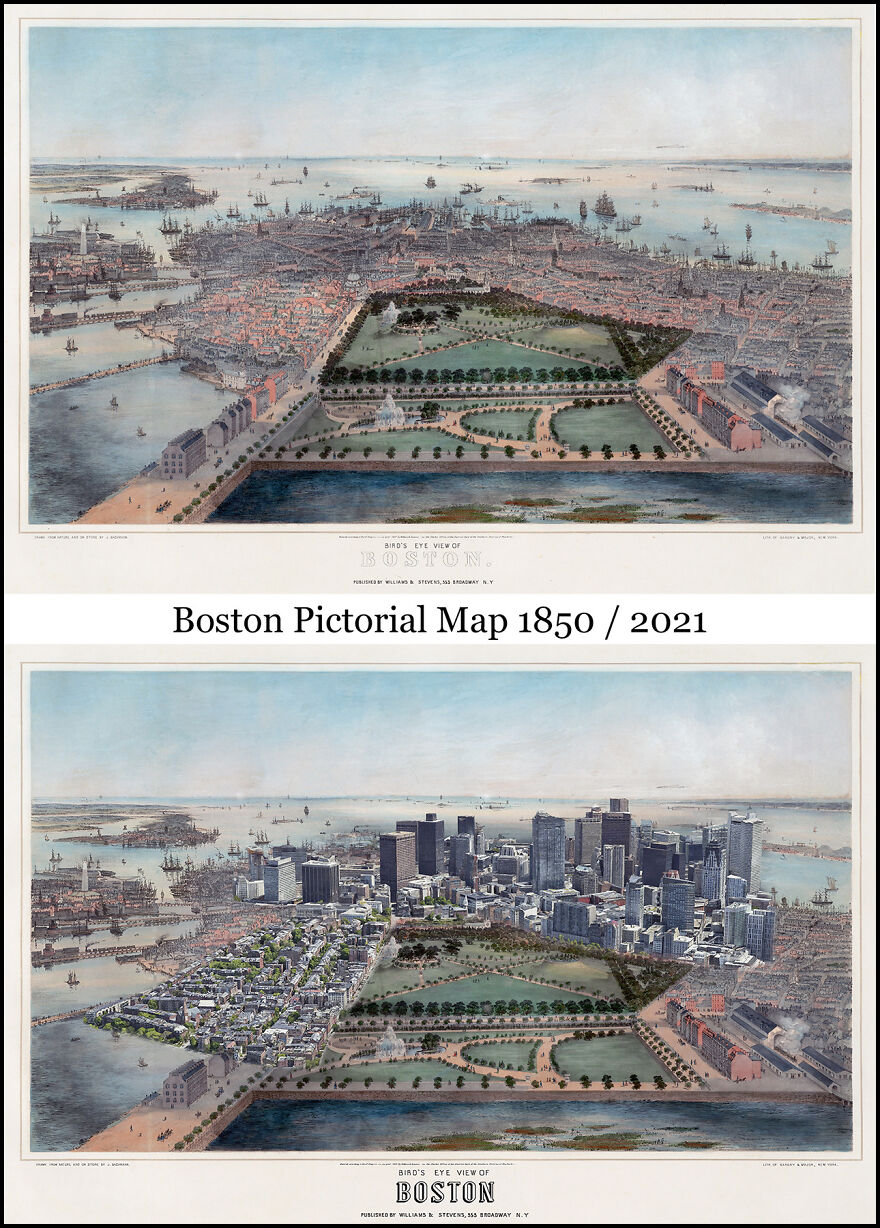
I’ve created two other sets of Time After Time images that people like, and so do I! The first is a collection of pictorial maps. Pictorial maps (also known as illustrated maps, panoramic maps, perspective maps, or bird’s-eye view maps) were popular in the mid-19th century. The most well-known was published by Currier & Ives. They employed painters, illustrators, and engravers to produce these incredible works of art.
Pictorial maps show an area as if viewed from above at an oblique angle. They are not generally drawn to scale, though many are accurate enough to be captured in a similar perspective today using aerial photography shot from the same angle. To do that, I used satellite imagery from Landsat and Google Earth to capture a shot from the same angle as the original map. I then blended them together – a combination of 19th-century engraving and 21st-century satellite photography. Pretty cool! I have done over 40 pictorial maps, with more to come.
Lastly, a number of my pieces show scenes containing buildings with neon signs and large windows, street lamps, cars with headlights, and other things that I thought would look interesting at night. So I used a digital technique known as day-to-night conversion and I did a whole series, using my original Time After Time image, and converting it into a nighttime scene. Some people think the nighttime scenes are better than the daytime scenes! You be the judge.
If you’d like to know more, don’t hesitate to get in touch.
Chicago, George Streeter And The Reutan 1902 / 2022

Chicago, Arriving From The Suburbs 1907 / 2019

Chicago, Wrigley Field 1939 / 2019

New York, Brooklyn Bridge 1899 / 2022

Boston Pictorial Map 1850 / 2021
Chicago, Dearborn Street Bridge 1918 / 2022

Chicago, Shore Drive Lincoln Park 1905 / 2016

San Francisco, Van Ness Avenue 1906 / 2018

Chicago, Boat House Lincoln Park 1905 / 2018

New York, Plaza Hotel 1900 / 2018

Baltimore, Pictorial Map 1880 / 2021

Chicago, Looking North From Van Buren Station 1915 / 2019

by Mark Hersch


